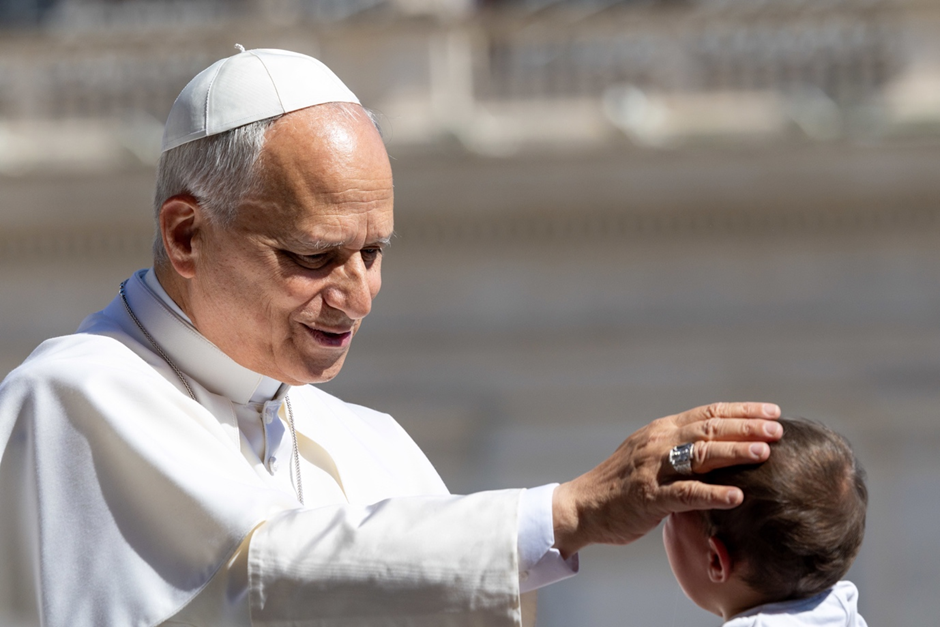
At his Wednesday General Audience held in St. Peter’s Square on 27 May 2026, Pope Leo XIV offered further reflections on Sacrosanctum Concilium, the Second Vatican Council’s 1963 Constitution on the Sacred Liturgy, highlighting the importance of liturgical renewal while preserving the Church’s authentic tradition.
Addressing priests and all who exercise the ministry of liturgical presidency, the Holy Father urged them to uphold the liturgical texts and norms with fidelity and reverence.
“Those who exercise the ministry of liturgical presidency must always uphold that respect for the texts and regulations of the liturgy which springs from an inner attitude of openness and trust in God, manifesting humility before His greatness and sincere fidelity to ecclesial communion,” he said.
The Pope emphasized that the renewal of the liturgy and its development throughout history have preserved tradition while enabling the Church to grow in unity and continue her mission of proclaiming the Gospel to all peoples.
Continuing his catechetical series on the documents of the Second Vatican Council, Pope Leo XIV noted that Sacrosanctum Concilium was the first document promulgated by the Council. He observed that it introduced significant liturgical reforms, including the use of vernacular languages in the liturgy to encourage the active participation of the faithful.
The Holy Father described the liturgy as a powerful instrument of evangelization throughout the centuries.
“The liturgy has been for centuries a driving force for evangelization,” he said. “Today, this energy must be renewed in continuity with the authentic and living Catholic tradition, in accordance with a dynamic aimed at introducing believers to the fullness of the truth.”
Drawing on the teachings of Pope Pius XII, Pope Leo XIV recalled that the Church is “a living organism” which grows, matures, develops, and adapts to the needs of different times, including in matters relating to the liturgy.
He explained that the reforms envisioned by Sacrosanctum Concilium sought to strengthen the Christian life of the faithful through a careful renewal of liturgical practices. According to the Pope, there was a strong awareness at the time of the Council of the need to renew ritual forms through which the Church glorifies God and sanctifies His people.
The Holy Father also referenced the teaching of Pope John Paul II, who highlighted the close relationship between liturgical renewal and the renewal of the Church’s entire life.
“A very close and organic bond exists between the renewal of the liturgy and the renewal of the whole life of the Church. The Church not only acts but also expresses herself in the liturgy, lives by the liturgy, and draws from the liturgy the strength for her life.”
Pope Leo XIV further stressed that authentic tradition and genuine progress should not be viewed as opposing realities. Quoting Pope Benedict XVI, he noted that tradition is a living reality that inherently includes development and growth.
He explained that the Council’s reforms were legitimate because they were firmly rooted in the Church’s authentic Tradition. The Church’s worship, he said, has always been embodied within the cultural expressions of different ages while retaining its essential identity and contributing to the work of evangelization.
The Pope also recalled that the Council Fathers insisted that any revision of the rites should ensure that new forms “grow organically from forms already existing.” He noted that every reform undertaken for the good of the Church must be preceded by careful theological, historical, and pastoral study.
To safeguard unity and avoid confusion among the faithful, the Holy Father reiterated the Council’s teaching that no individual should add, remove, or alter anything in the liturgy on personal initiative.
Concluding his address, Pope Leo XIV emphasized that the liturgical progress envisioned by the Council does not weaken ecclesial communion but rather strengthens and promotes it.
“The progress evoked in the Conciliar Constitution in no way compromises ecclesial communion; rather, it seeks to confirm and foster it.”
Anita Aryeh
DEPSOCOM, Accra


