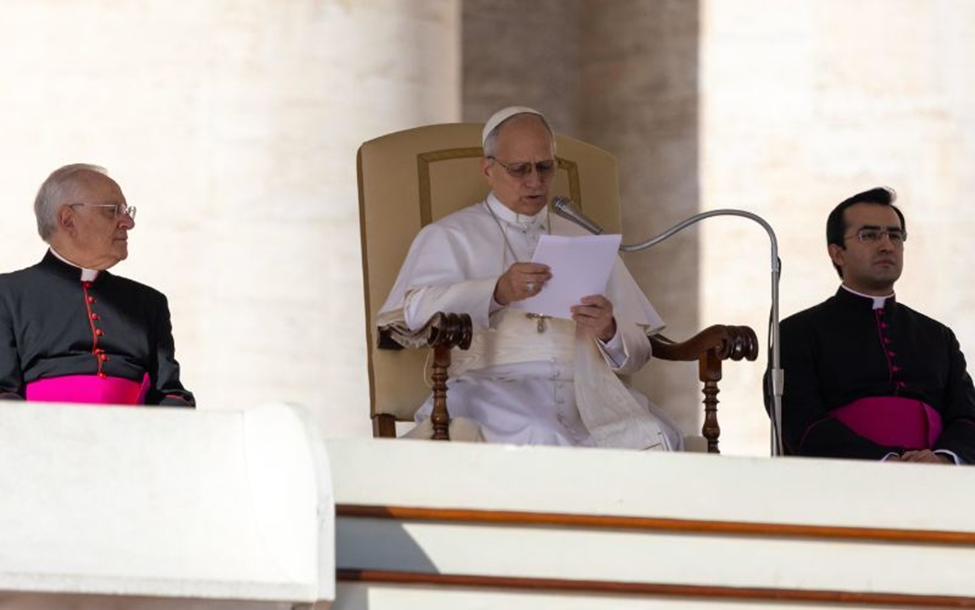
Pope Leo XIV has emphasized the transformative power of the liturgy, describing it as a privileged means through which believers draw closer to God and rediscover what is essential in their spiritual lives.
Speaking during his General Audience in St. Peter’s Square on Wednesday, June 3, 2026, the Holy Father reflected on the Second Vatican Council’s 1963 Constitution on the Sacred Liturgy, Sacrosanctum Concilium. He explained that the liturgy helps Christians return to God amid the distractions and pressures of daily life.
“With the solemn simplicity of its rhythms, the rites interrupt our frenetic activities, leading us back to what is essential,” Pope Leo XIV said.
The Pope noted that the rites of the liturgy invite believers to pause from their busy schedules and focus their attention on God, thereby fostering a deeper relationship with Him. He stressed that authentic participation in the liturgy requires the involvement of the whole person.
“Rites give shape to liturgical action and thus to our lives by generating in us a spiritual sensibility that makes us capable of savouring the presence of God through Jesus Christ, if we participate actively in the liturgy with our full selves—body, mind, and heart—and avoid being strangers or silent spectators,” he explained.
Reflecting further on the nature of liturgical rites, Pope Leo XIV acknowledged that their structured sequence of prayers and gestures may sometimes seem at odds with contemporary preferences for spontaneity. However, he emphasized that these rites are not intended to restrict human freedom but rather to deepen the faithful’s encounter with God.
The Holy Father also reflected on the importance of signs and symbols within the liturgy. He explained that while signs and symbols are often used interchangeably, symbols possess a deeper significance because they communicate a broader system of meanings and values.
Using holy water as an example, the Pope noted that when the faithful are sprinkled with holy water, they are reminded of the grace received through Baptism and their commitment to new life in Christ.
Drawing from Sacred Scripture, he traced the rich symbolism of water throughout salvation history—from the creation account, the Flood, the crossing of the Red Sea, and the River Jordan, to the water that flowed from Christ’s side on the Cross. These events, he explained, reveal water as a profound sacramental sign of participation in Christ’s death and resurrection.
The Pope further highlighted the significance of liturgical actions such as kneeling, exchanging the sign of peace, and participating in the sacraments. He noted that these symbols possess a transformative and performative dimension, shaping both the individual believer and the wider Christian community.
According to the Holy Father, liturgical symbols foster a sense of belonging, engage both heart and mind, and give rise to authentic ecclesial relationships.
Concluding his catechesis, Pope Leo XIV encouraged the faithful to allow themselves to be formed and educated by the rites of the liturgy. He called for careful attention to the beauty and integrity of liturgical celebrations, free from arbitrariness and personal innovation.
“Let us allow ourselves to be educated by the rites of the liturgy, caring for the beauty of our celebrations with a delicate touch and without arbitrariness,” he urged.
The Pope added that a vibrant and prayerful liturgical life, supported by sound mystagogical catechesis, remains one of the Church’s most effective means of helping people encounter God.
“The experience of a living and devout liturgy, accompanied by appropriate mystagogical catechesis, is the best resource for reawakening in everyone that openness to the encounter with God which, in the logic of the Incarnation, can only take place by involving the whole person: spirit, soul, and body,” he said.
The Holy Father’s reflection served as a reminder of the central role of the liturgy in the life of the Church and its enduring power to draw believers into a deeper communion with God.
Story by: Anita Aryeh
DEPSOCOM, Accra


