CATHOLIC WOMEN CALLED TO RISE AGAINST VIOLENCE AND DISCRIMINATION
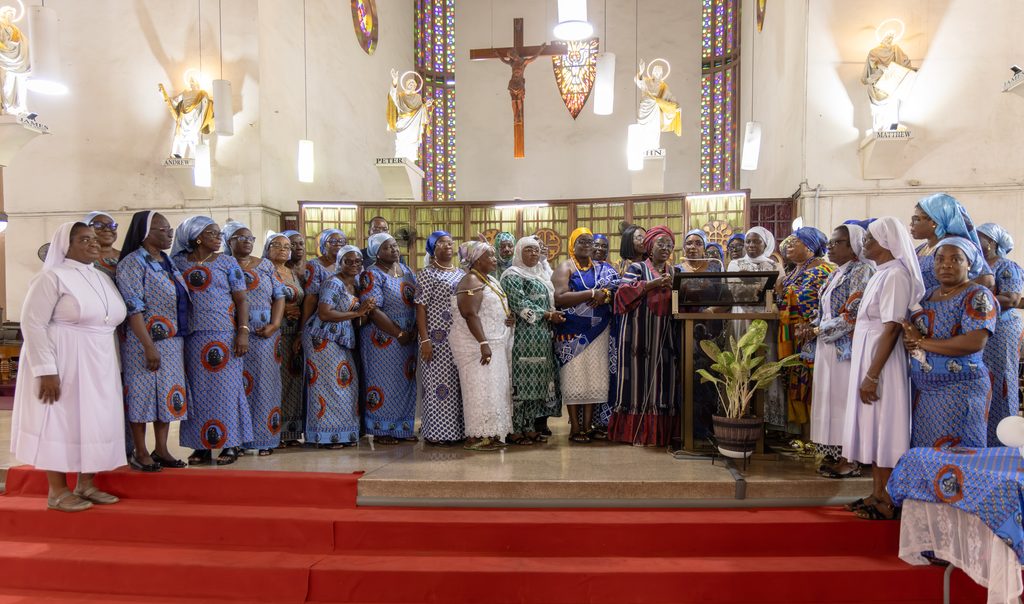
On Saturday, 19th September 2026, the Accra Archdiocesan Council of Catholic Women (AACCW) celebrated the World Union of Catholic Women’s Organisations (WUCWO) Day at the Holy Spirit Cathedral, Adabraka, with a strong call on women to rise with renewed faith, unity and courage to confront violence and discrimination against women and girls.
The celebration, held under the theme, “Women, Let us Ignite our Faith, Fuel our Passions and Unleash our Potential for Unity and Peace,” focused on the topic, “Let us Eliminate Violence and Discrimination against Women and Girls.” It brought together Catholic women from various parishes and communities, priests, religious sisters, Queen Mothers, representatives of other Christian denominations, the Ahmadiyya Muslim Women Association, and other invited guests.
In her welcome address, the President of the AACCW, Madam Rita Amivi Wurth-Seddoh, welcomed the dignitaries and participants and expressed gratitude to God for bringing women together for the celebration. She said the occasion was not merely a gathering but an opportunity for Catholic women to renew their commitment to the dignity, protection and advancement of women and girls.
Madam Wurth-Seddoh said women had a significant responsibility in building peaceful families and communities and therefore needed to use their faith, talents, voices and positions to promote justice and unity. She encouraged women not to remain silent in the face of violence and discrimination but to support victims and work towards creating environments where women and girls could live safely and with dignity.
She further called on women to support one another and avoid attitudes and actions that could contribute to division and discrimination. She urged the Church, families and society to pay greater attention to issues affecting women and mothers and to translate concern into practical action.
The Guest Speaker, Hon. Abla Dzifa Gomashie, Minister for Tourism, Culture and Creative Arts, challenged women to take up leadership responsibilities at all levels and not to allow fear or difficult experiences to prevent them from making their contribution to society.
Drawing from her own experience, she spoke about encountering discrimination and feeling victimised during her working life. She said such experiences had taught her important lessons about the need for women to remain resilient and continue to contribute to society while also standing up for justice and dignity.
Hon. Gomashie noted that violence against women and girls was not limited to physical abuse. It could also be sexual, emotional, psychological, and economic, and could occur in homes, schools, workplaces, communities, and digital spaces. She stressed that violence is not love and called on women and men to reject every form of abuse.
Referring to Genesis 1:27, she reminded the gathering that every woman and girl possesses God-given dignity. She also drew attention to Ephesians 5:25, urging husbands to love their wives as Christ loved the Church, rather than use control, intimidation or violence in relationships.
The Minister called for greater investment in girls through education, protection, mentorship and opportunities. She explained that economic empowerment was important because it could give women the ability to make choices about their lives and seek safety when faced with abusive relationships.
She further called on men and boys to become active partners in ending violence and encouraged fathers to teach their sons respect for women. She urged religious and traditional leaders to use their moral authority to speak openly against abuse and to ensure that violence was not dismissed as a private family matter when a woman or child was at risk.
Hon. Gomashie also challenged the creative sector to contribute to the fight against discrimination by using films, music, theatre, literature and digital content to challenge harmful stereotypes and promote positive images of women and girls. She encouraged women involved in the creative economy to seek skills, mentorship, entrepreneurship opportunities, market access and leadership positions, stressing that women must be given the opportunity to develop and use their God-given talents.
Delivering the keynote address on behalf of the Minister for Gender, Children and Social Protection, Hon. Dr. Agnes Naa Momo Lartey, the Chief Director of the Ministry, Dr. Marian W.A. Kpokpah, commended Catholic women for their years of faith, service and sacrifice to families, communities and the nation. She described women as an important part of Ghana’s social support system and said the persistence of violence against women and girls required collective action from government, religious institutions, traditional authorities, families and communities.
Dr. Kpokpah explained that domestic violence was not only a family issue but also a public health, economic, child protection and national development concern. She said many cases continued to go unreported because victims often faced fear, shame, economic dependence and pressure to remain in abusive relationships. She highlighted Ghana’s legal framework for protecting women and children, including the Domestic Violence Act, 2007 (Act 732), Human Trafficking Act, 2005 (Act 694), Children’s Act, 1998 (Act 560), and the Affirmative Action (Gender Equity) Act, 2024 (Act 1121), as well as laws addressing harmful practices affecting women and girls.
Dr. Kpokpah also mentioned institutions and mechanisms established to support vulnerable persons and survivors, including the Domestic Violence and Victim Support Unit (DOVVSU), Social Welfare, Legal Aid, CHRAJ, shelters, the Domestic Violence Management Board and Secretariat, and the Livelihood Empowerment Against Poverty (LEAP) programme.
She, however, stressed that legislation alone could not eliminate violence. She called for stronger enforcement, increased public education, improved access to services, greater awareness of legal rights and a change in social attitudes that allow abuse and discrimination to continue. According to her, faith and traditional institutions were indispensable in the fight because of their influence, trust and reach within communities. She therefore encouraged religious and traditional leaders to listen to survivors, believe them, make appropriate referrals and ensure that pastoral reconciliation did not compromise the safety of women or children.
Dr. Kpokpah explained that the newly established coalition was being led by women of faith and traditional women and was not a government-owned initiative. She said government would instead work alongside the coalition to strengthen efforts to prevent violence, support survivors and promote the rights and dignity of women and girls. She encouraged the coalition to use the pulpit, traditional palaces, schools, communities and other platforms to speak against violence, make institutions safer and fairer and hold duty bearers accountable. She also provided information on support services, including the Orange Support Centre helpline 0800-111-222 and WhatsApp 055-1757575, as well as grievance redress services through the Single Window Citizen Engagement Service.
The Queen Mothers at the celebration also made a strong appeal for unity among women. They urged women to become one another’s keepers and to support those who were struggling rather than undermine them. They acknowledged that violence and discrimination could occur in different settings, including religious communities and even among women themselves. They therefore called on women of faith to demonstrate genuine love, unity and concern for one another.
The traditional leaders pledged to support women and girls who experienced violence and help direct victims to appropriate institutions for assistance. They also encouraged Catholic women to begin the transformation from within their own families and communities. They called on women to be the voice for the voiceless, teach their sons to respect women, encourage their daughters to rise, and work with communities to protect women and girls.
The event also witnessed the launch of the Coalition of Religious and Traditional Women Against Violence and Discrimination by Hon. Abla Dzifa Gomashie. The coalition brings together women from religious and traditional backgrounds to strengthen collaboration in preventing violence and discrimination and supporting women and girls.
In his acceptance remarks, the Chairman of the Accra Archdiocesan Laity Council, Mr Timothy Sowah, pledged the support of men for the initiative. He said men, particularly as husbands, fathers, brothers and sons, had a responsibility to stand with women in the fight against violence and discrimination.
He stressed that when mothers, wives, sisters and daughters were wounded by violence or discrimination, the entire family, Church and society were affected. He therefore called for partnership between men and women in creating safer and more just communities.
In his closing remarks, Mr Sowah urged participants to move from prayer and discussion to action. He reminded them that the celebration had brought women together to pray, listen and launch a new initiative and that the real test would be how they lived out the message after the programme.
The programme also featured fundraising in support of the Legacy of Hope Project, an initiative aimed at supporting women and families, including the provision of a mothers’ lodge at the Children’s Cancer Hospital and the establishment of a women’s health research centre.
The celebration concluded with Holy Mass, during which Rev. Fr. Sylvester Segbawu encouraged the Catholic women to arise, renew their faith, and remain confident in God despite the challenges they may encounter.
Rev. Fr. Segbawu urged the women to approach their challenges with faith and courage.
Reflecting on Psalm 56, whose response says, “I will walk in the presence of the Lord in the land of the living,” he reminded the women that God remains with His people even in moments of rejection, opposition, fear and difficulty. Using the examples of David and Joseph, he explained that God could rescue His people from situations that appeared impossible. He also shared experiences from his own priestly journey to emphasise the need to trust God even when circumstances become difficult.
Reflecting on the Hebrew, Rev. Fr. Segbawu prayed that God would rescue women from every snare, danger and plot directed against them and grant them strength to overcome their challenges. He ended by encouraging the women to remain on the Lord’s side, trusting that God would continue to guide, protect and strengthen them as they work for peace, unity and the dignity of women and girls.
Several distinguished traditional leaders attended the celebration, including Naa Adoley Anyaado I, Queen Mother of Laterbiorahie; Manye Naa Badu Adiagba I, Queen Mother of Abelekpe/Dzorwulu under the Osu Stool; Naa Adei Mankobi Anunyam I, Queen Mother of Akorlu, Nyamekye enclave; and Naa Adoofo Ajoorbo I. Also present were Sample Freedom Akwei-Bu Manye of the Mothers’ Union, Anglican Diocese of Accra, representatives of the Ahmadiyya Muslim Women Association, Catholic women, priests, religious sisters, and other invited guests.
The celebration served as a renewed call for Catholic women and women of goodwill to transform faith into action by protecting the vulnerable, supporting one another and building families and communities where every woman and girl can live with dignity, safety and hope.
Story by
Thelma N.E. Impraim -Holm
Depsocom Accra


