When Father Corby Gave General Absolution to 530 Men at Gettysburg
While it was common in Europe to grant general absolution to soldiers going into battle, this was the first time it had ever occurred in the United States.
It was almost noon, July 2, 1863, and the 530 men of New York’s Irish Brigade were resting on the eastern slope of Cemetery Ridge above the small town of Gettysburg. They could hear the fire of muskets and artillery at Little Round Top, but the Irish were being held in reserve. Then the order to came to prepare to march into battle.
As the Irish gathered their equipment, one of the brigade’s chaplains, Holy Cross Father William Corby, climbed on top of a boulder and called for attention. There was no time for him to hear the confession of every man of the brigade individually, he explained, but in such an emergency the Catholic Church permitted a priest to grant general absolution. He instructed them to recall their sins, beg God’s pardon, and recite silently the Act of Contrition, just as they would if they were in a confessional.
Father Corby drew from a pocket of his black frock coat a violet stole. As he draped it around his neck, the men of the Irish Brigade removed their caps and knelt on the grass. Raising his right hand he made the sign of the cross over the brigade as he recited the words of absolution: “May Our Lord Jesus Christ absolve you, and I, by His authority, absolve you from every bond of excommunication and interdict, insofar as it lies within my power and you require; therefore, I absolve you from your sins, in the Name of the Father, and of the Son, and of the Holy Ghost. Amen.” A member of the Irish Brigade, Colonel St. Clair Mulholland of the 116th Pennsylvania, would write later that while it was common in the Catholic countries of Europe to grant general absolution to soldiers who were about to go into battle, this was the first time it had ever occurred in the United States. Among the kneeling men, Mulholland recalled, “there was a profound silence … yet over to the left, out by the Peach Orchard and Little Round Top … the roar of battle rose and swelled and re-echoed through the woods.”
The men rose from their knees and marched down the slope of Cemetery Ridge toward farmer John Rose’s wheat field.
The Irish Brigade had missed the first day of the battle — they were still on their way north from Maryland. It was about 10:00 at night on July 1 when they reached the outskirts of Gettysburg and made camp in the fields that belonged to farmer Jacob Hummelbaugh. They were roused at 4:30 the next morning, July 2, 1863, to follow their officers to Cemetery Ridge, a part of the battlefield where, at the moment, there was no fighting. To pass the time until they received orders, the Irish and their comrades in the Second Corps sprawled on the grass and played cards or took a nap. Shortly after noon they came under Confederate fire. It was at this moment that Father Corby gave general absolution to the Irish.
Father Corby was not supposed to be the chaplain of the Irish Brigade. Very likely he would have been left in peace to teach at the little college in Indiana that his fellow Holy Cross Fathers had founded and christened “Notre Dame.” Alas, the first chaplain assigned to the Irish had proven to be something of a disappointment.
When the brigade was formed in New York City in April 1861, just days after the harbor batteries in Charleston had fired on Fort Sumter, Archbishop John Hughes named Father Thomas Mooney chaplain to the Irishmen who had volunteered to fight for the Union.
Father Mooney was an irrepressible, impulsive young man. As curate of St. Brigid’s Church in New York’s East Village Father Mooney had demonstrated a knack for saying the wrong thing, to the irritation of his parishioners, and doing the wrong thing, to the annoyance of his superiors. Yet, Archbishop Hughes had faith that eventually Mooney would mature.
Mooney joined his men at Old St. Patrick’s Cathedral (not the one on Fifth Avenue, the one downtown in what is now Little Italy) where Archbishop Hughes said Mass for them and blessed their battle flag. Then the Irish Brigade boarded a steamship and cruised south to Washington, D.C.
They were encamped on the grounds of Georgetown College. Here, for seven hours a day, several cadets from West Point drilled the Irish, transforming raw recruits into soldiers. Day after day, more men and more military equipment poured into the camp, raising the level of excitement. The New York Irish were eager to prove themselves in battle, and Confederate territory lay just across the Potomac River, in Virginia.
Father Mooney, impressionable man that he was, shared the high spirits of his men. On the day a new cannon rolled into camp, the Irish were exuberant. It must have been contagious, because Mooney suddenly appeared among the troops in cassock, surplice, and stole, with a bucket of holy water in his hand. In a burst of enthusiasm, before the entire Irish Brigade (and anyone else who happened to be passing by), the priest baptized the cannon. History does record what name he gave it. We can assume it was a saint’s name.
Someone wrote of the spectacle to Archbishop Hughes, and not long after the “baptism,” Father Mooney received an angry letter from the archbishop. “Your inauguration of a ceremony unknown to the Church, was sufficiently bad, but your remarks on that occasion were worse.” Unfortunately, like the cannon’s name, what Father Mooney said at the baptism has not survived. We do know that Hughes ordered the impetuous young cleric back to New York. And so, to his surprise, Father Corby was assigned to fill the void left by Father Mooney.
When the Irish Brigade formed in New York in 1861, they numbered 2500 men. At Gettysburg they were down to 530. Of the men Father Corby absolved that day, 27 were killed, 109 were wounded, and 62 were listed as missing.
The casualties the Irish Brigade lost on July 2 were hard to bear, but they were barely noticeable when compared to the losses the armies of North and South suffered in three days of heated fighting. The Union lost about 21,000 men, and the Confederates lost between 23,000 and 28,000. Overnight the 2400 inhabitants of Gettysburg found themselves overwhelmed by the task of burying thousands of dead, nursing and feeding thousands of wounded, and finding ways to dispose of more than 5000 dead horses and mules.
Every church, every school, every house was used as a hospital. Sarah Keefauver Weikert, 21 years old, lived with her husband John and their two-year-old daughter, Jennie, in a farmhouse at the bottom of Little Round Top. Before the shooting started, they fled to the home of friends. When the family returned after the battle, they found their house was being used as a hospital. “I looked into the front door,” Sarah wrote later, “and there were so many dead men lying on the floor that it would have been impossible to have walked through the hall without stepping on the bodies.”
In the days after the battle, a great wave of visitors flooded into Gettysburg. These family members and friends came to claim the bodies of their beloved dead or tend wounded loved ones. The few rooms in the town’s hotels and taverns had filled long ago, so most the visitors relied on the kindness of the citizens of Gettysburg, who made up beds for the strangers on the floors of their homes or in their barns. The Broadhead family nursed three wounded soldiers in their home, and provided shelter to twenty out-of-towners. This was not unusual.
You’ll find two monuments to the Irish Brigade at the lovingly tended Gettysburg National Military Park. One is a 20-foot-high stone and bronze Celtic cross. It was dedicated exactly 25 years after the Irish went into battle—July 2, 1888. On that day surviving veterans of the brigade erected a temporary altar at the foot of the cross, and Father Corby said Mass there for them. The monument is in a wooded area on Sickles Avenue. It’s a bit hard to find, but one of the park’s rangers can direct you. By the way, the sculptor of the monument was an Irish veteran of the Civil War, William R. O’Donovan — he fought for the Confederacy.
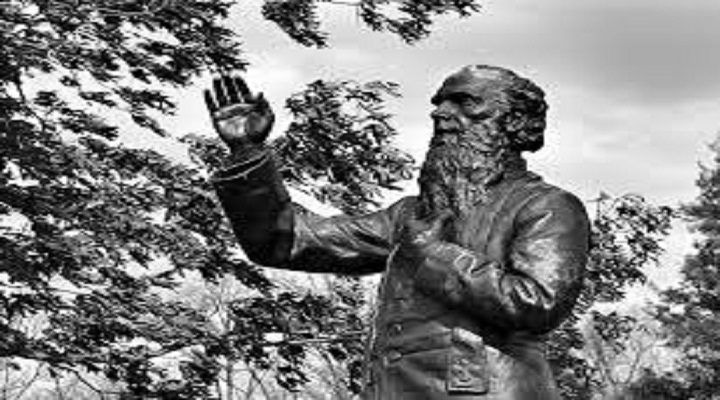
Much easier to find is the Father William Corby Monument — it’s right on Hancock Avenue, the most traveled road through the park.
The somewhat-larger-than-life-size bronze sculpture of Father Corby stands on the rock where he stood before the Irish Brigade went into battle, and shows him with his right hand raised, granting absolution to his men.
By the way, a duplicate of the sculpture stands on a boulder outside Corby Hall at Notre Dame.
The Catholic Register


